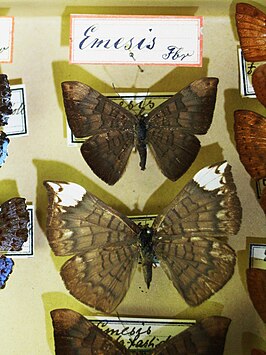
Erbrechen ist ein Sex von Schmetterlingen der Familie der schöne Schmetterlinge (Riodinidae), Unterfamilie riodininae.
Erbrechen wurde in 1807 erstmals wissenschaftlich beschrieben von Fabricius.
Typen
Erbrechen umfasst folgende Typen:[1]
- E. adelphaLeCerf, 1958
- E. aerigera(Stichel, 1910)
- E. angleisHewitson, 1870
- E. ares(W. Edwards, 1882)
- E. arnacisStichel, 1928
- E. aurimna(Boisduval, 1870)
- E. borealis(Grand & Robinson, 1866)
- E. brimoGott Mann & salvin, 1889
- E. castigataStichel, 1910
- E. cereus(Linné, 1767)
- E. cilixHewitson, 1870
- E. condignaStichel, 1925
- E. cratidaDoppeltag, 1847
- E. croninaSchaus, 1928
- E. cypriac. & R. Felder, 1861
- E. diogeniaPrittwitz, 1865
- E. elegiaStichel, 1929
- E. emesia(Hewitson, 1867)
- E. eurydikeGott Mann, 1903
- E. fastidiosaMenetrien, 1855
- E. fatima(Cramer, 1780)
- E. fatimellaWestwood, 1851
- E. fulmen(Stichel, 1910)
- E. glaucescensTalbot, 1929
- E. guppyiKaye, 1904
- E. guttata(Stichel, 1910)
- E. heteroklitaStichel, 1929
- E. heterochromHopffer, 1874
- E. irina(Stichel, 1928)
- E. Iris(Staudinger, 1876)
- E. LakrinenHewitson, 1870
- E. liodesGott Mann & salvin, 1886
- E. lucinda(Cramer, 1775)
- E. lupinaGott Mann & salvin, 1886
- E. lycortasDoppeltag, 1847
- E. maeonisDoppeltag, 1847
- E. mandana(Cramer, 1780)
- E. mutic(McAlpine, 1937)
- E. NeämienHewitson, 1872
- E. nilus(Felder, 1861)
- E. nomaeaDoppeltag, 1847
- E. ocypore(Geyer, 1837)
- E. orichalceusStichel, 1916
- E. peruviana(Lathy, 1904)
- E. PoeasGott Mann, 1901
- E. progne(Gottmann, 1903)
- E. pseudomandanaRobert, 1927
- E. rabatta(Dyar, 1916)
- E. rawsoni(McAlpine, 1939)
- E. russulaStichel, 1910
- E. satema(Schaus, 1902)
- E. saturataGott Mann & salvin, 1886
- E. sinuataHewitson, 1877
- E. sinuatusHewitson, 1877
- E. spretaH. Bates, 1868
- E. tegulaGott Mann & salvin, 1886
- E. temesa(Hewitson, 1870)
- E. tenediac. & R. Felder, 1861
- E. toltecReakirt, 1866
- E. tristisStichel, 1929
- E. velutina(Godman & Salvin, 1878)
- E. vimenaSchaus, 1928
- E. vulpinaGott Mann & salvin, 1886
- E. wrighti(Holland, 1930)
- E. xanthosa(Stichel, 1910)
- E. zelaDiener, 1870
| Quellen, Anmerkungen und/oder Verweise |
 Wikimedia Commons
 Wikispezies