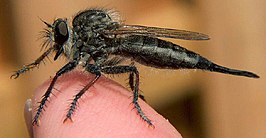
Efferia ist eine Gattung von Räuber fliegt (Asilidae). Der wissenschaftliche Name der Gattung wurde erstmals gültig veröffentlicht von Daniel William Coquillett im Jahr 1893.[1] Im Jahr 1910 zeigte Coquillett Efferia Candida als die Typ Typ Auf.[2]
Diese Gattung kommt in der Neue Welt und ist dort die umfangreichste Raubfliegengattung mit (im Jahr 2012) mehr als 230 beschriebenen Arten und vielen noch nicht beschriebenen Arten.[3]
Diese schwarzen oder grauen Raubfliegen sind opportunistische Raubtiere; sie greifen alle möglichen anderen Insekten an, meist im Flug. Die Beute von Efferia staminea sind andere diptera aber auch verschieden Homoptera, Hemiptera, Neuroptera oder Hymenopteren.[4] Die Fliege injiziert mit ihrem Hypopharynx (einem ihrer Mundwerkzeuge) Proteasen in seine Beute und saugt anschließend seine verflüssigten, verdauten Körperteile auf. Manchmal muss sie dies an mehreren Stellen derselben Beute wiederholen.
Typen
- E. Aestuans(Linné, 1763)
- E. albibarbis(Macquart, 1838)
- E. albiventris(Macquart, 1850)
- E. amarynceus(Wanderer, 1849)
- E. anacapai(Wilcox & Martin, 1945)
- E. anomal(Bellardi, 1861)
- E. anomal(Bellardi, 1861)
- E. antiochischWilcox, 1966
- E. anzaForbes, 1988
- E. apicalis(Wiedemann, 1821)
- E. argentifrons(Hine, 1911)
- E. argyrosoma(Hine, 1911)
- E. aridus(Williston, 1893)
- E. armatus(Hine, 1918)
- E. aurimystaceus(Hine, 1919)
- E. auripilus(Hine, 1916)
- E. aurivestitus(Hine, 1919)
- E. aztekischWilcox, 1966
- E. BasingerieWilcox, 1966
- E. BasiniWilcox, 1966
- E. Bastardi(Macquart, 1838)
- E. beameriWilcox, 1966
- E. belfragei(Hine, 1919)
- E. Benedikt(Bromley, 1940)
- E. bexarensis(Bromley, 1934)
- E. bicaudatus(Hine, 1919)
- E. zweifarbig(Bellardi, 1861)
- E. bryantiWilcox, 1966
- E. cabezaWilcox, 1966
- E. CalienteWilcox, 1966
- E. californicus(Schäffer, 1916)
- E. CandidaJakobsmuschel, 1893
- E. canellus(Bromley, 1934)
- E. canus(Hine, 1916)
- E. caymanensisScarbrough, 1988
- E. clementei(Wilcox und Martin, 1945)
- E. abgeschlossen(Macquart, 1838)
- E. abgeschlossen(Macquart, 1838)
- E. Jakobsmuschel(Hine, 1919)
- E. costalis(Williston, 1885)
- E. couleiWilcox, 1966
- E. Kressonia(Hine, 1919)
- E. cuervanus(Hardy, 1943)
- E. chapadensis(Bromley, 1928)
- E. davisiWilcox, 1966
- E. DesertionWilcox, 1966
- E. duncaniWilcox, 1966
- E. ehrenbergicWilcox, 1966
- E. femoratus(Macquart, 1838)
- E. frewingiWilcox, 1966
- E. gilaWilcox, 1966
- E. grandis(Hine, 1919)
- E. halliWilcox, 1966
- E. harveyic(Hine, 1919)
- E. helenae(Bromley, 1951)
- E. imperialisForbes, 1988
- E. InkognitaForbes, 1987
- E. Inflation(Hine, 1911)
- E. Unterbrechung(Macquart, 1834)
- E. jubatus(Williston, 1885)
- E. Möglichkeitensis(Hine, 1919)
- E. kelloggiWilcox, 1966
- E. knowtonia(Bromley, 1937)
- E. kondratieffBullington und Lavigne, 1984
- E. latrunculus(Williston, 1885)
- E. leukokomus(Williston, 1885)
- E. LunaWilcox, 1966
- E. MakroxiphaForbes, 1988
- E. Mesquite(Bromley, 1951)
- E. Mönch(Bromley, 1951)
- E. mortensoniWilcox, 1966
- E. nemoralis(Hine, 1911)
- E. neoinflataWilcox, 1966
- E. neosimilisForbes, 1987
- E. ordwayaeWilcox, 1966
- E. pallidulus(Hine, 1911)
- E. ParkenWilcox, 1966
- E. pavida(Williston, 1901)
- E. pernicisJakobsmuschel, 1893
- E. pilosus(Hine, 1919)
- E. pinaliWilcox, 1966
- E. plenus(Hine, 1916)
- E. pogonien(Wiedemann, 1821)
- E. prairiensis(Bromley, 1934)
- E. prattii(Hine, 1919)
- E. Produkt(Hine, 1919)
- E. produktiv(Osten Sacken, 1887)
- E. pumila(Macquart, 1850)
- E. rapax(Osten Sacken, 1887)
- E. Schaden(Bromley, 1951)
- E. setigeraWilcox, 1966
- E. singularis(Macquart, 1838)
- E. slossonae(Hine, 1919)
- E. verschneit(Hine, 1919)
- E. speciosa(Philippi, 1865)
- E. spiniventris(Hine, 1919)
- E. Ausdauer
- E. stramineus(Williston, 1885)
- E. subappendiculatus(Macquart, 1838)
- E. subaridus(Bromley, 1940)
- E. subkupreus(Schäffer, 1916)
- E. subpilosus(Schäffer, 1916)
- E. tabescensBanken, 1919
- E. tagax(Williston, 1885)
- E. texanus(Banken, 1919)
- E. tolandiWilcox, 1966
- E. tricella(Bromley, 1951)
- E. tricellus(Bromley, 1951)
- E. truncatus(Hine, 1911)
- E. tuberculatus(Coquillett, 1904)
- E. tucsoniaWilcox, 1966
- E. utahensis(Bromley, 1937)
- E. variiert(Williston, 1885)
- E. Wirbel(Bromley, 1940)
- E. wilcoxi(Bromley, 1940)
- E. willistoni(Hine, 1919)
- E. yermoWilcox, 1966
- E. yumaWilcox, 1966
- E. zonatus(Hine, 1919)
Quellen, Anmerkungen und/oder Verweise- ↑D. W. Jakobsmuschel. "Eine neue Gattung der Asiliden, die mit Erax verwandt ist." Der kanadische Entomologe voll. 25 (1893), S. 175.
- ↑D. W. Jakobsmuschel. "Die Typusart der nordamerikanischen Gattungen von Diptera." Proceedings of the United States National Museum voll. 37 (1910), S. 536
- ↑Aubrey G. Scarbrough, Lawrence E. Stevens, C. Riley Nelson. "Das Albibarbis-Komplex von Efferia Coquillett, 1910 aus der Grand Canyon Region im Südwesten der USA, mit drei neuen Arten und neuen Verbreitungsnachweisen (Diptera: Asilidae). Der panpazifische Entomologe voll. 88 (2012), S. 58-86. DOI:10.3956/2012-07.1
- ↑Kevin M. O'Neill, Ruth P. O'Neill. "Korrelate der Fütterungsdauer bei der Räuberfliege" Efferia staminea (Williston) (Diptera: Asilidae)." Zeitschrift der Kansas Entomological Society, voll. 74 Nr. 2 (2001), S. 79-82.
|
 Wikimedia Commons
 Wikispezies